My September update got lost in the events of Labor Day weekend. It happens. At least I’ve been making progress on my goals. In some cases, it’s been big strides towards the next step of the project. In other cases, it’s been frustratingly slow.
Projects
Even small, daily work on each project has kept things moving forward.
I’ve been tackling the big conflict of The Colonel Lieutenant, even if it’s just taking a single scene and working through a few paragraphs. It’s been particularly frustrating because this conflict has a lot of moving parts that move at different speeds (I’ve gamed it out twice) trying to find the right balance of strain, action, decision and consequences. I think I have a good balance now, but we’ll see how it looks when the draft comes to an end.
I’m taking a new tack with Orcfyre. First, I focused the scope on a narrow narrative, avoiding an epic backdrop to the story for a easily manageable tale. Second, I re-worked the planned character development for both main characters so it’s more realistic, and so it ends in a better place for book 2. And I made some adjustments to the world building so its more refined.
I reviewed my first draft of the 1st Minnesota story and confirmed it was really, really boring. The character going through the events of training without any conflict was just not any fun. He was passively experiencing things. So, I’ve brainstormed some ideas for how to make it interesting and I’m ready to take a second shot at it.
As for my other projects, there’s been significant work on the planning and world building, and more than 10K words written. Some of them have real potential. Others, I’m slowly sliding further down the scale of importance.
I continue to be frustrated by how difficult it is to find time to read, even with a kindle by my bed, an app on my phone, and more than a few physical books. I have bursts of time where I get a lot of reading done. But I keep getting distracted. I want to read more, and I wonder if not reading more is why I’m having a hard time writing much.
Something to focus on in October.
That being said, I did manage to finish one book in October: Promise of Blood, the first book in the Powder Mage series. This book is set in a world with various levels of magic usage, including people who can use and manipulate gunpowder in mystical ways (for example, sniffing gunpowder to enhance their senses). This was a fascinating book that has a perfect first chapter I might write a blog post on. A few hiccups in that I think the writing and world building could be stronger, but still well worth reading. I’ll have to look into the next few books at some point.
October Goals
20 Minutes Reading each day
Finish one research book
Finish one non-fiction book
Finish one fiction book
Movies and Shows
Modern Family Season 2 – 11
Star Trek: Strange New Worlds Season 4
Ted Lasso Season 4
Avatar: The Way of Water
I binged through Modern Family through August and September. This show was surprisingly funny, with a lot of good, memorable moments. The characters were varied, and grew over the course of the show, even the ones I thought were annoying. And, thankfully, there were only a handful of episodes I want to go back and re-watch, so I don’t feel the need to re-binge the entire show.
I’m trying to get through Strange New Worlds Season 4. I say trying because…its not very Star Trek. It’s got the interesting characters, but its not telling Star Trek stories. It’s telling weird and gimmicky stories because those can happen in Star Trek. And they’re not telling them very well. It’s very annoying, and I can’t really bring myself to get excited for them.
Ted Lasso Season 4 is, at the time of this writing, one episode shy of done. I’m very nervous. On the one hand, I’ve enjoyed most of this season. It was a rough start. Episode One was great, a good dedicated explanation of how Ted goes back to London. Two and Three were slow (I wish they could have been one episode), but then the series picked up. The problem is, they did not specify what the series victory goal was until Episode 9 of 10 (every other season said what it was in episode 1: avoid relegation, get promoted, win the championship), so it’s been hard to gauge how the team is doing. And the threat to the team has been ominous but nebulous, so it’s been hard to understand how much danger there is. Without those concrete backstops, the season just hasn’t had the same impact. I’m worried the last episode will upset me.
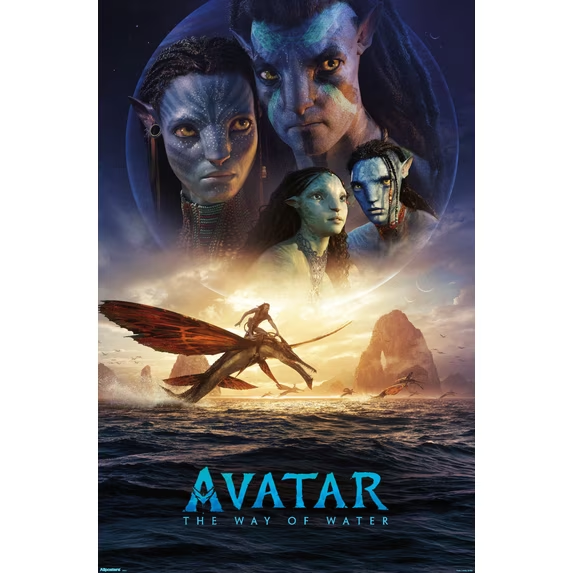
I watched one new movie these past few months, which was Avatar: the Way of Water. Similar to the first movie, it has a familiar story: an imperialist power has come to a land to ravage it for resources, provoking a response. The local leader (who used to be one of the imperialists) is an effective leader, but moves his family away for their protection. The imperialists send forces to hunt him down, using brutal tactics that lead to violence, unnecessary death, and a climactic confrontation. But the Avatar movies aren’t about the story. They’re about the beautiful world built and shot and displayed. It’s a wonder in 4K.
October Goals
Finish 3 Seasons of TV
Watch 3 Movies
Games
Horizon Forbidden West
Anno 1800
Terra Invicta
Dark Souls
Forbidden West continues to be a fun game, exploring the ruins of the world inhabited by giant machine beasts. It borders on having too many side missions and questions (like Farcry games tend to do), but also I only play two or three hours a week, so no surprise I’m still working my way through it.
I’m following a new strategy in Anno 1800 that should finally get me up to the highest levels of civilization. The strategy is to specialize each island as much as I can and use ships to transport goods between islands. It’s working so far; I’ve gotten much further, with a much stronger economy than I ever have before. And I’m slowly building it stronger. Maybe I can finally get it all done.
Terra Invicta? No idea what I’m doing. I’m still trying to figure this out. I think I need another hundred hours of YouTube videos before I’ll have any idea what I’m doing here. Similar (but opposite) thing with Dark Souls, which I started playing with a friend of mine as a way to spend time together. There the gameplay is relatively simple, but I don’t understand the world. At least I’m still having fun.
October Goals
Just keep playing, enjoy the games, and have fun. Don’t worry about it.
What’s Next?
I have some things I’ve applied for but haven’t heard back on, so nothing in the next few months. There is QuantumCon next year, for sure. And MiniCon, I think (I should check and make sure I’ve signed up for that).
As we ended the last post, I had the game ready to go. Pieces were set. Rules established. Now to see how the Sur-Marais invasion of the Valle del Cielo progresses.
Note: I may have mentioned in an earlier post or two that it is important to save your work. Well, I have the list of town names. And I have the map. But if I ever had a key that showed which names went to which town, I have since misplaced it. So, I’m going to proceed and do my best with what I’ve got.
The game map at the start of the game.
Turn 1
Turn one is fairly simple. The Sur-Marais army corps begins marching east out of Santa Catrina. In one day, their infantry can only march two hexes, but their cavalry contingent can march three. Their cavalry marches on Santa Lucia and attacks the scouts based there; pushing them back.
The battle occurs later in the evening, causing a delay in any warning being sent east.
Turn 2
The Campilesian scouting elements fall back east. A message (the yellow line) is sent ahead, but only makes it halfway to San Martin before night fall.
The Sur-Marais corps stops in Santa Lucia to consolidate and rest. Afterall, they haven’t come across any noticeable opposition.
Turn 3
I stretched the messenger to represent a major effort for the rider to get to San Martin by the end of the day (Stealing or buying more horses, multiple riders, etc). The main characters are now aware of the invasion and are making preparations.
The Sur-Marias corps pushes its cavalry up to skirmish with the enemy cavalry outside of San Miguel. The brigade there is fortifying their positions, but they’re about to be attacked by ten times their number, and by professional soldiers. Everyone is nervous. Their general is a fine man, but he’s not an experienced soldier. Civilians begin fleeing east.
One allied scouting element stays to the north. The southern element drops further south to watch the forest road.
Turn 4
The Sur-Marais corps advances east, marking to Santa Isabella, only a few hours march from San Miguel. Their cavalry is skirmishing heavily with the cavalry between the two settlements. The corps does leave behind some troops to secure the town, but given its size, it’s a battalion of a few hundred troops.
The brigade in San Martin has started to march west, but due their inexperience, most units don’t march more than a miles or so out of town. The brigade doesn’t march out of its starting hex (this represents the difficulty of early American Civil War armies in marching anywhere).
Turn 5
The Sur-Marais corps attacks San Miguel. The battle is short; the Campilesian troops are inexperienced, and between enemy artillery and their mass of troops advancing, they run and fleet east. What remains of the brigade falls back east to Santa Margarita.
The brigade out of San Martin managed to march several miles westward. The main characters are still in San Martin, but they will be leaving soon. There are messages being traded with higher commanders outside the valley for reinforcements and aid. Maybe it will come, maybe it won’t.
Where are we?
Five turns in and I’m already facing a different story than I expected. The enemy corps has advanced halfway up the valley in five days and taken the central settlement. The first battles have been won easily by the more professional force. And the main characters are slowly advancing.
What I had expected was the first battle to occur with both Campilesian brigades on hand, instead of only one. But with what I built, there was no real reason to expect the Sur-Marais corps to hold back at all. An experienced, aggressive general with an easy victory within grasp? Why not attack?
Now, I have two options for how to proceed.
Option One: Rework to match my initial thoughts
Maybe I like my original plan. I need to either slow down the Sur-Marais corps, or speed up the Campilesian response. Of the two, I would slow down the corps. Perhaps weather comes into play, making the roads mud and impassible.
Or the general in charge becomes lazy. Perhaps he chooses to march one day and rest and secure for two or three days, consolidating his lines of communication or interrogating the locals. Maybe he’s scouting more. Or using engineers to build brigdes and improve roads.
The point is, if I want to slow them down, I have many external forces or interna decisions I can use to change their intertia.
Option Two: Consider the story as it would proceed from here
Putting the enemy halfway up the valley in less than a week puts the pressure on the protagonists to throw everything into the next battle to keep the enemy from taking San Martin. Perhaps they’re desperate enough to do something crazy.
With the forest road, there is a chance to get some troops behind the enemy lines. Maybe the characters leave a small skeleton force to hold the line and march around? Doubtful, and militarily stupid given the force disparity, but an option. Sending a cavalry raid is much more likely.
But, let’s also not forget that there are none combat options here to be utilized. They could resort to theatrics (quaker guns or repetitive marches) to convince the enemy there are more troops around than there actually are. Counter operatives could spread false rumors of troop movements. they could burn bridges.
If they want to buy time, there are options. Buying time for reinforcements to come in and fortifications to be built.
The point is, the speed of the first five days can add a strong motivation to the characters to think outside the box and act with conviction. And that can make for a good story.
Conclusion
In only five turns, this game has already shown how my original plan for the story did not take into consideration how quickly the situation could change. I shouldn’t have been too surprised; I know many stories where such things happen in military history. But at least now I know; I have a framework with which to build a timeline for the decisions and their consequences.
The game isn’t meant to tell the story. It’s meant to help me keep it realistic, and to help me track of complex systems that can be easily mixed up. Through this example, I believe I’ve shown how such a game works in the PBRG process.
I’ll see you again for the next Writing Process Post; a review of the PBRG process.
This update covers three full months. The reason is explained below.
May was a fun month, with Quantumcon taking up a weekend, and the rest filled with work, writing and goals. The suggestion schedule continued to work well, but as I said the previous update, I need a better way to focus on the important projects and make sure I hit deadlines. Particularly with the major projects and the blog posts.
June was a difficult month. It started with the sudden loss of a close friend of mine. That knocked me off my schedule, and turned June into a month of grief, recovery and meditation. I got some things done, but I wasn’t following my schedule at all.
July I was getting back to normalcy, or at least trying to. I revamped the suggestion schedule to make it more efficient, focusing on reducing the number of suggestions each day and organizing them in a better fashion. It helped me get back into some semblance of productivity. I’m writing again.
Projects
I added little bits and pieces to all my projects, adding a few thousand words here, working out some world building there. Some projects I advanced more than others, and it wasn’t always the major projects. So, for August, I’m adding a single goal for each project. if and when I knock one of the goals out, I can set it aside (except for the major projects, in bold. Those ones I keep working on.
August Goals
Project
Goal
Blog
Publish two blog posts
The Colonel Lieutenant
Break 120,000 words
Ocrfyre
Break 30,000 words
1st Minnesota
Rewrite and Revise First Day
Dress Reds
Break 30,000 words
Resurrection
Break 25,000 words
Contrition
Break 25,000 words
Retirement
Work out overall plot and timeline
Light Star Short Stories
Each short story to 5,000 work
Tales of the Templars
Overviews for each Story
Commonwealth
Write one battle scene
SAF
Plot out the story arcs
Light Star Conarth Story
Outline and plot the story
Sasha 4
Outline and plot the story
Champion Impact
Finish getting responses from backers
Books
War and Peace (Fiction; Audiobook)
Seven Basic Plots (Research)
Mr. Lincoln’s Army (Non-Fiction)
The Measure of Magic (Fiction)
The First Volunteers (Research)
Second to None (Research)
The Paradox of Choice (Non-Fiction)
Promise of Blood (Fiction)
I’ve been advancing through the books. A few chapters here and there. Reading continues to be a frustrating thing to carve time out for. But I did just change my sleeping setup, so my phone charger is not next to my bed. What is close by is a kindle and my pile of books. I’m hoping by reducing the amount of time I spend phone surfing before and after sleep, I can read more.
August Goals
Finish one research book
Finish one non-fiction book
Finish one fiction book
Movies and Shows
Image courtesy of Wikipedia.
Stargate SG1 Season 1
Stargate SG1 Season 2
Starfleet Academy Season 1
Project Hail Mary
This is Spinal Tap
Spinal Tap II: The End Continues
Chernobyl
The Odessey
Sinners
Modern Family Season 1
Get ready, because I watched a lot of things this summer so far.
Movies
I managed to get out to the theater to see Project Hail Mary on the big screen. I’d read the book and was excited to see it as a movie. It did not disappoint. It was beautiful, and it caught the big dramatic points of the story. The changes from the book were acceptable, and they even added a scene that I wish had been in the book.
Fourth of July weekend I did a double header: This is Spinal Tap, and Spinal Tap II: The End Continues. I loved both films, both for the movie and for the soundtrack. I enjoyed the characters, and the story was hilarious. I’m glad I finally watched it.
I made it out to the theaters a second time to see The Odessey. Now, it has been a while since I’ve read the text, but I remembered enough to follow the story and catch most of what was changed. The film incorporated history in a way I wasn’t anticipating but greatly appreciated. A fantastic film. Eager to watch again and start nitpicking things.
I also sat down to watch Sinners, the gothic horror, semi-musical period piece. This movie was a surprise; it was not a horror film in the sense that I thought it was. Plus, everything I thought had been spoiled was either wrong, or in the context of the film, meant something different. Very enjoyable.
TV Shows
TV show wise, I marked several seasons off my list. I finished the first season of Stargate SG1 and moved into Season 2. This show is a lot of fun, and I can see why it lasted for so long.
I finally finished Starfleet Academy. I have mixed feelings about this. The show started and ended pissing me off, but the middle-bits, when the characters were students, resonated with me. It felt like Star Trek, as the characters challenge themselves to be better than they are, rather than exploring the galaxy. But, again, the show begins and ends in ways that upset me. We’ll see how Season 2 goes.
Finally I started and finished the miniseries Chernobyl. I’d heard a lot of good things about this show, and it did not disappoint. From the great acting to the intense storytelling, it delved deep into the story of the disaster I knew very little about. No, it was not historically 100% accurate, but it was still worth watching.
August Goals
Watch three movies
Finish three seasons
Games
Humankind
Horizon Forbidden West
Anno 1800
Terra Invicta
I added to my play throughs for several games. Managed to loose a game of Anno 1800, which I didn’t know you could do. I’ve ended up researching how to play it better; my goal is to get to the highest levels of the civilization.
I’m also getting further into Horizon Forbidden West; the story has picked up a bit, and I’m really enjoying how the game challenges me to play it better. But how far am I into it? Unclear. I think a quarter to a third.
Finally, I started trying to learn Terra Invicta. This game is one of those ones that looks amazing, but has a steep learning curve and is further hindered by a poor tutorial. I’ve taken to YouTube for how-to-play videos. But I’m hoping to figure this game out.
August Goals
Advance games.
Have fun.
Don’t stress
What’s Next?
I don’t have anything on the books right now. I’ve got some applications in. We’ll see what, if anything, comes of it. For now, I’m focusing on self care and learning to write again.
To show the narrative game process, I’m going to game out the campaign in the Valle del Cielo, between the Campilesia Independent Forces and the invading Sur-Marais Army. This post will set up the game. The next post will play it out.
The Map
I took the map I had previously created for The General of the Pen and I added a hex overlay. It’s thicker than I would have liked, but it’s what I could do quickly. Clearly, the map is not set up for the hex overlay, as cities and villages are not quite centered, but again, I did this pretty quickly.
Each hex is roughly ten miles from center to center.
The Rules
This game is going to track how fast units move about the valley. Each round is one day.
Units
Every unit on the map is going to represent one independent formation, moving under by the decisions of one commanding officer. This could be as small as a squadron of 300 soldiers, or an entire army corps of 30,000.
Each unit has a movement speed, which represents how fast the unit can move about in one day. This speed will be limited to the slowest formation in its order of battle, either infantry (foot and wagon speed) or cavalry (mounted horse speed).
The units will not have the same speed necessarily. The well-drilled Sur-Marais infantry can pack up and march quicker than the newly raised Campilesian volunteers. On the other hand, while the Campilesian cavalry is not well-drilled, they are all expert horsemen, so they will move the same speed as their professional counterparts.
Faction
Unit
Speed
Sur-Marais
Infantry
2 hexes
Sur-Marais
Cavalry
3 hexes
Campilesian
Infantry
1 hex
Campilesian
Cavalry
3 hexes
Unit composition
Other than changing the movement, the composition of any unit on the field will have several other influeces.
The unit commander’s knowledge of strength will inform their deicisons.
A unit with cavalry can ‘scout’ the nearby hexes to find out what is nearby.
Larger units will eat up supply quicker. While I’m not tracking supply by numbers, it will something to keep under consideration for narrative purposes.
Messengers
It’ll be important to remember that in this world, there are no radios or telephones. There are telegraphs, but they exist only between major cities, so they won’t have much of an impact on this game. Narratively, that any information known in San Martin (the capital city of the valley) is known to the greater Campilesian movement beyond, which may have an impact. I’m giving myself that options.
A message dispatched by an officer will move up to 50 miles (5 hexes) in one day. This is a bit messier to track, but important to know when certain officers know about events further down the valley. And it’ll be one more reason to have the character try to build a telegraph down the valley.
Commander Choices
Finally, I need to make the choices for each unit from the viewpoint of the commander of that unit, at that time an place. I want to take into account:
Their education and training
Their skill and talent (or lack thereof)
What they know
Their mission
Their biases and personality.
Starting Positions
In this step, I set units about the battlefield and decide what their current composition it. I figured out most of this in earlier blog posts where I built the armies, but now I get to see it on the map.
The Sur-Marais force is in the west, at the large town / small city of Santa Catrina. Here, I’m going to place two markers. One represents the force sent to pacify the valley. An army corps, supplemented by two additional cavalry brigades. Around 20,000 men at arms, all told. The second marker represents the garrison force of Santa Catrina, to guard the supplies. I’ll say this is a brigade of infantry, some artillery, and a lot of supply clerks. Maybe 4,000 men, all counted. They won’t do much, except represent the enemy ‘base.’
The Campilesians are spread out. They have a brigade at San Martin in the east (three battalions of infantry and an artillery battery, 2,600 men). And a brigade I will put at the crossroads (also three battalions and a battery, but only at 1,800 men). There are also about seven hundred scouting the west. I will put three tokens down, for each of the three scouting units, representing where they’re focused on looking.
I’m also going to add markers for the main characters of the story, at least as far as they make it into the game. One for the allied commander, Major General Alonso de Mendoza, and one for the POV character, Gerhard Van Rumm.
The red enemy forces in the west stand ready to advance down the valley. Three markers indicate where scouts focus their efforts. Blue forces sit near the crossroads and the city to the east. The gold and silver circles represent the two main characters of the story.
Beginning the Game
I’ve got the tables for each unit on the board, with their subordinate units and some notes on their commanders.
I have the starting places for the units.
I have the established rules.
Starting the next blog post, I will begin playing the game.
Writing a story comes from a place of plot, building something for the characters to experience that the readers will enjoy. But when it comes to complex scenarios that occur during such stories, the initial rough draft will often be more plot oriented and inconsistent. To work out those scenarios, iron out the inconsistencies and retain the exciting plot, I’ve found it helpful to game out the scenarios.
Please note: a game can represent any scenario, but so far, I've dealt mostly with military battles and campaigns. Therefore, this blog post will speak mostly about gaming out battles. There are some games I have set up for non-campaign projects, but I'm still working through them, and I want to keep them secret for now.
What is a Game?
First, let’s establish what I mean by a game.
A game is a physical representation of a complex scenario from one of my books. This representation allows me to process the scenario, watching all its component parts.
To do this, I need:
A star map for a science fiction project.
A map of a geographical area. In some cases, I might make an organizational relationship. It largely depends on what I need to track. But so far, it’s been geography.
I need tokens to represent units, characters, locations. And participant in the game that I want to track. This may come with a key or stat card for the tokens.
A set of rules to guide the game. These rules will tell me how much time passes each turn, how far units can move, how terrain impacts movement, and things such as that.
A timeline to track the passage of time and events that occur each turn. One game I took pictures of the board each round and tracked everything. Another game, it was just notebook pages. At some point, spreadsheets will be involved.
There are also aspects which might be unique, or at least not universal, to particular games. Maybe one game I need to worry about supplies. Another game, the political relationship between factions. Most games might not require their own specific rulesets, but I should be open to building them if necessary. It all depends on what I’m trying to build.
Which leads us to….
Why ‘play’ a Game?
To be clear, the purpose of a game is not to roll dice and see who wins a contest. I’m not putting the plot of the story into question. But what I can do is use the game to watch and consider the complex situations and check them for common errors and opportunities.
A good battle scene may require both the bird-eye (strategic) or authorial and the ground-level (tactical) or character points of view.
1. Keep units moving realistically
It’s a very common error on my part in early drafts: people and ships move at the speed of plot. At the end of one rough draft, I realized an entire company of characters had moved thirty miles in an hour by horseback. It’s something I’ve become aware I need to pay attention to.
Since most of the games I’ve played so far have been military campaigns, movement rules are important. The general in charge of the dramatic campaign would know how to stagger his orders so all the units would — or at least should — arrive at their attack points at the correct time. Yes, things could get in the way, but orders are written with the best of intentions. Until I get in the way (see #3, below).
2. To notice bad decisions (for characters or author)
This works hand in hand with reason 1; my initial campaign idea is usually plot driven. When I lay it down on a map and start moving units around, I notice things that the decision-makers in the story would notice. For example:
This company captured this village early, which means this road was cut. I can’t use the road later. Either the company can’t capture it early, or I have to find other ways to move things around.
This officer made a decision that doesn’t make sense on the read through; she would have to trust that an enemy unit wouldn’t attack or move, and there’s no way she would know that. She has to make a better decision, or I have to explain a more flawed on.
This unit spends much of its time in action without running out of ammo. How is it resupplying? Or is it resupplying at all? I’ll need to address this.
3. To see from unnamed character’s eyes
If early drafts of a battle are plot driven, they’re usually from the viewpoint of one or two characters. Units and other characters will appear and disappear as needed, and events will flow from their POVs.
But a battle involves dozens, hundreds or even thousands (or more) people, and many of them can influence its course through their decisions. By looking at the game from the top-down POV, I can see a dozen such decision points each turn of the game, with characters making choices based off incorrect decisions seen through personal biases.
Things happen behind the scenes that may not even be mentioned in the book, but they can influence how and where people and groups show up in the story. I may even think of entirely different ways to fight, flow or end the battle.
Influence on the Story
The influence is on subsequent drafts is pretty clear (at least to me, the one who has to read all the drafts, over and over again). Battles flow more realistically. Units deal with supply issues, casualties and travel times. Characters make better or worse decisions of incomplete information, and the impact of those decisions ripples across the battlefield, and the story.
Now, all I have to do is take my rough draft and incorporate the lessons of the game into the next draft. In some ways this is easy, as I have a wealth of new information to add to the story to tell the important parts better. On the other hand, there’s also a lot of extraneous information I may feel like flooding the reader with. And I don’t want to do that. Yes, I gamed everything out, but the reader doesn’t want to read about every decision 30 officers made over three days of battle.
Does that mean a lot of effort was made, recorded and wasted?
Not at all. It’s just hidden behind the curtain.
Gaming the General of the Pen
Here is where I would normally do a section on gaming a part of General of the Pen, but I realized pretty early that a good game would take too long to put as a section of blog post. So, I’ll make that the 11th chapter of this series.
Conclusion
The word game is not meant to leave the fate of the story to rolls of the dice. It is meant to add structure to the world and keep my storytelling realistic, or at least consistent. By using a map, tokens, and a set of rules, I can make sure the characters go through events that meet the needs of the story, but don’t take the reader out of it with ridiculous movement jumps, stupid decisions, or forgotten units.
Join me next time when I show you how this works by taking my original plot for General of the Pen and setting a game to it.
March was productive. I continue to work on my projects, advance each of them as they come up (some more than others). I knocked out quite a few shows and movies. Overall, it was a good month.
Projects
I’ve added several thousand words to The Colonel Lieutenant, and solved several plot issues that I’d been worried about. The big challenge now: to get the big end-of-book campaign done in a short enough word count. My goal is to get the book done in under (or close to) 150,000 words. If it looks to exceed that by too much, I’ll look at cutting it into two books. But I’m hoping I don’t have to do that.
I did something with Orcfyre I probably should have done a while ago: I ripped it apart. I took what I had from the several drafts I’ve done through and ask myself three questions: What do I want to keep? What do I want to get rid of? And what do I want to add? Then I threw out the outline and came up with a new one, something considerably shorter and easier to write. This new story will be much easier to process, but hit all the same points I want it to to set up Book 2. Will it work? I don’t know. But I feel much better about it than I did the previous outline.
My other projects are working well. I got some new book recommendations to add to my 1st Minnesota research collection and they’re adding a lot of valuable information. Dress Reds and Resurrection are both coming along nicely. And I came up with some solutions to issues with Contrition and Retirement that give me a better idea of how to write those stories.
So, a very good month.
April Goals
The Colonel Lieutenant: Get to 100,000 words
Orcfyre: Get to 10,000 words in new outline
1st Minnesota: Outline 1st Book, get to 10,000 words
Other projects: Keep working and writing
Books
War and Peace (Fiction, Audiobook)
Seven Basic Plots (Research)
Mr. Lincoln’s Army (Non-Fiction)
The Measure of Magic (Fiction)
The First Volunteers (Research)
Second to None (Research)
Ashen Light (Fiction)
I sat down to read Ashen Light, the second book by Ian Young, a friend of mine from local conventions. This book was great; a science fiction detective novel, with elements of space exploration, corporate BS, and system hackery. It was even better than his first book. If you liked Blade Runner or Asimov’s robot detective novels, you’ll like this one.
I added several research books to my pile, all regarding the 1st Minnesota. They’re going to be very helpful in writing that book, but it also means I’ve added several new titles without having finished the previous ones. Oh, well, it happens.
April Goals
Finish Two Books (any type)
Movies and Shows
Image courtesy of Wikipedia
Starfleet Academy Season 1
Stargate SG1 Season 1
Foundation Season 1
How to Train Your Dragon (Live Action)
The Naked Gun (2025)
Wake Up Dead Man
I finally sat down and finished Season 1 of Foundation. The show ended on a strong note. It took a while to get there; an enjoyable route, to be sure, but one where all the twists kept me from finding my footing. By the end of season 1 I was there. I’m liking the show; the aesthetic, the casting, and the story. I’m excited to see where it goes.
The first of three movies I watched this month was the live action How to Train Your Dragon movie. This was a decent movie. Not a great departure from the animated film. The only big difference was the world building; it gave more history and lore to the background and characters. So, glad I watched it, not missing too much by not watching it again.
Then I watched The Naked Gun remake from 2025, with Liam Neeson. I was worried, because the original trilogy was something I grew up watching, so it’s very dear to me. This new edition held up. It was hilarious, almost the entire way through. Almost. The ending wobbled a bit for me, but not enough to detract from my enjoyment. I ended up watching it again the next day.
And finally I saw Wake Up Dead Man, the third Knives Out murder mystery movie. This one follows the murder of a priest in rural New York, and it is probably the best of the three movies (though maybe not my favorite). This movie continues to switch up the type of mystery, bring out a stellar cast, and keep me guessing as to the truth of the killer until it’s revealed.
April Goals
Watch three movies
Finish three seasons
Start a TV Show that isn’t science fiction
Games
Surviving Mars: Relaunched
Star Trek Voyager – Across the Unknown
Horizon: Forbidden West
Hogwarts: Legacy
Did not finish any games or goals this month. Did play some, but when I had time to sit down, I was usually writing. I’m playing a second game of Across the Unknown to see what I can do differently. Picking through the rest.
April Goals
Finish one game
Start another game
Coming Up Next
I have a table at Minicon, April 2 to 5, though the authors are only there the 3rd to 5th. I’m taking the 2nd off to recover from a rough few weeks at work. Then I’ll be at Quantum-Com 4, May 15th through 17th.
June of this year included my launch party, but it was dominated by my 9 to 5. My office job took up a significant amount of my energy this month, enough that I fell behind on most of my goals. It happens. We adjust and we move on.
Projects
There are still a number of minor bits for Champion Impact I need to finish, such as getting the PDFs up for sale on my website and finishing the ebooks for the supplements. Things that I should be done with but I keep getting distracted from.
I’m making good progress on The Colonel Lieutenant. Over the last month I started a printed copy of the project so I can re-read what I’ve got and see it from a reader’s perspective. I’ve also worked through several of the plot points. Which is good, though it will require some revisions and re-writes (but what doesn’t?). I also took a stab at some of the maps for the book, though this is a very initial stab. It’ll take several iterations to come up with something I like.
I nipped at a few other projects. There was a pass at Orcfyre, my ever-illusive fantasy novel, which wasn’t ‘this is it!’ but was informative. I want to get some scenes from other projects written soon, if only to get a feel for the story and their characters: and to stretch my creative legs a bit.
July Goals
Finish at least a good scene guide to The Colonel Lieutenant, if not have a rough draft ready to go.
Finish a scene guide to Orcfyre
Knock half of the bullet points of my Champion Bold Remember to finish this list!
Complete one to-do item for each other project
Books
Image Courtesy of Wikipedia
War and Peace (, Fiction, Audiobook)
Without Remorse (Fiction, Re-Read)
Patriot Games (Fiction, Re-Read)
Hell to Pay (Non-Fiction)
The Seven Basic Plots (Research)
Idiot’s Guide to Game Theory (Research)
The Elves of Cintra (Fiction)
Ashen Light (Fiction)
Man, I got into or worked through a lot of books last month.
Re-reading the Ryan-verse (Tom Clancy’s series, Without Remorse and Patriot Games) is fun. It’s the first adult series I read growing up, and I used to read through the books every year. I haven’t touched them in a decade. That means that in this re-read, I’m picking up on things I hadn’t noticed before, because my mind is no longer used to the books. Plus, I’m older and mature enough to notice new things. It’s fantastic.
The Elves of Cintra is okay, but not particularly exciting. I don’t know why, it seems to have all the elements but they’re just not synching as much as I’d like. I’m worried that when I get back to the Shanarra books of my childhood I’ll find them just as out of synch as these books.
I’m enjoying reading through The Seven Basic Plots, one of my research books. It’s a large book I picked up a long time ago and never got around to reading, but it’s helping me think about my stories and how they could be better, or at least more unique. I’m hoping they’ll help me get some of my stalled projects up and running.
Movies and Shows
Image courtesy of Wikipedia
Last Kingdom
Bad Batch
Clearly, I did not make as much of an effort at watching shows as I did at reading. Which is fine.
I’m continuing to re-watch The Last Kingdom in preparation of watching the final movie. I’m still surprised how much of this show I don’t remember. I know I watched through it multiple times years ago, but I guess it just didn’t stick. I’m guessing because the books are still better.
I did start a new show last month: Bad Batch, a Star Wars animated show. I’m only a few episodes in, but I like it. It’s got some interesting characters, and it’s a different sort of Star Wars story than I’ve experienced before. I’m eager to see how it goes.
July Goals
Finish One Show
Watch One Best Picture Winner
Watch One Fix-It Title
Start New Show
Games
Image courtesy of Wikipedia
Space Marine 2
Horizon Forbidden West
Last of Us (Replay)
Stellaris
I got to finish a video game and start a new one last month! Huzzah!
I finished Space Marine 2, a 40K first person shooter. This game was fun, and it really immersed you in the universe. I particularly enjoyed how the between mission sections allowed you to walk around and listen to side conversations and hear about other events. But it wasn’t a great game, on the level of Gears of War or Halo. I haven’t quite put my finger on why; the closest I can say is that it comes off as far too cartoony, and not quite as serious, as the other titles I mentioned.
With a game done, I could start a new one: Horizon Forbidden West, the sequel to Horizon Zero Dawn, which is generally on my list of favorite games of all time. I’m excited to get into the game; the first bit is already just as amazing as I’d expected.
I want to get a PC story game going; I’ll have to consider some options. Probably something strategic or national.
On the RPG front, one of my games is starting to wrap up, which means we’re building characters for the next chapter. That’s always fun. The game I’m running is going well, with the characters getting into the spirit of troll fighting. As I expected, this chapter is a lot easier to plan and execute than the last one.
July Goals
Advance Horizon Forbidden West
Start PC Game
Continue enjoying Stellaris
Coming Up
I don’t have anything planned for now; no conventions or appearanced.
July Goals
Get a convention or appearance planned.
That’s all for this month. I’ll see you all soon for more blog updates and — hopefully — news of new appearances.
May was a busy month. I finished sending out Champion Bold physical packages. I had a convention, QuantumCon, which was a bit of a last minute addition but worth attending. There were good books and good shows. And as always, writing, world building, and procrastination. the good news is, I head into June with more books published, a short story accepted into an anthology, and a launch party on the way.
Projects
Champion Bold is mostly done. The physical copies of the novel and the supplements are available. The ebook of the novel is up. I still need to finish the supplement ebooks and PDFs and get those up. I should have had them done by now, but once the book is up I find myself looking towards the next project. Lesson learned: get the minor stuff done before the big finale, otherwise you lose focus.
I got a good amount of work done on the Colonel Lieutenant, though not as much as I’d hoped. I’m running into some issues of ‘is this working right’ or ‘did I set this up enough.’ There’s no real way to get around it, so I’m putting my head down and running right into the issues. No way to finish it except by doing it.
And, happily enough, I managed to get a large number of items done off my other project lists. Either small world-building things, or a few scenes I banged out. And some brainstorming that got me past a couple of project blocks, allowing me to figure out major plot points for some very low-level projects. Very excited for how those will workout.
June Goals
Finish Champion Bold ends
Finish the Colonel Lieutenant
Process Champion Impact Responses
Complete revised synopsis of Orcfyre
Knock 10 things of other to-do lists
Books
Image courtesy of Wikipedia
Armageddon’s Children (Fiction)
The Elves of Cintra (Fiction)
War and Peace (Fiction, Audiobook)
The Seven Basic Plots (Research)
Complete Idiot’s Guide to Game Theory (Research)
Without Remorse (Fiction, Re-Read)
Hell to Pay: Operation Downfall and the Invasion of Japan (Non-Fiction)
I’m into the second trilogy of the Shannara series, which has gone from modern fantasy to post-apocalyptic fantasy. The world has gotten a lot bleaker, and there are factions of demons and paladins warring for control of the future. I’m kind of enjoying the series, but it’s not really grabbing my attention. I’m hoping this book picks up the pace a bit, so I don’t feel like I have to force myself to read. And I’m still five books away from the ones I read as a kid.
My re-read of Tom Clancy’s Ryan-verse is going okay. It’s been a long time since I’ve read these books, and it’s gone much as I’d hoped. I’m remember why I liked it, but after so long away, not only do I still enjoy it, but I’m picking up things I’d never noticed before, or didn’t understand. It’s a much different read now. And I’ve still got 10 more books before I hit the end of the main series and the books that Clancy himself wrote.
Hell to Pay is a fascinating history book. It’s covering the planned Allied Invasion of Japan, and it’s doing it pretty well. Each chapter covers one aspect of the plan, without worrying about chronology. So when we discuss Allied recruitment efforts or Japanese defense planning, we get to read everything important in one chapter, without jumping topics. I’m looking forward to finishing it.
June Goals
Finish one fiction title
Finish one non-fiction title
Finish two research titles
Movies and Shows
Image courtesy of Wikipedia
Last of Us (Season 2)
Marco Polo
Last Kingdom (Re-Watch)
Andor (Season 2)
Captain America: Brave New World
In May I finished two great second seasons.
In Last of Us Part 2, we see the story of Joel and Ellie continue, much as it does in the second game. This season follows roughly the first half of that game, and it does it pretty well. It hits the emotional high points, but does so in its own way. I think the pacing was a bit off (another episode or two would have helped), but i don’t hate it. Expect a better blog post shortly.
And then there’s Andor Season 2, the last season of this show. Holy crap, talk about an amazing show. The show covers roughly four years of time, leading up to Rogue One and the original Star Wars movie. Great characters, amazing sets and costumes, and a story that just kept me wanting more. Even the last scenes gave us a good wrap up for the characters we wanted to know about. No complaints.
Finally, I saw the new marvel film, Captain America Brave New World. It was good, but not great. This movie had some high points, and some interesting connections to other films in the series. It didn’t quite feel as firm as other Captain America movies, but that’s a fairly minor complaint overall. I would definitely watch it again, but I wouldn’t start someone into the MCU with this one.
June Goals
Watch one Best Picture Winner (three left)
Watch one Fix-It Title (four left)
Finish one in progress show
Start one new show
Games
Stellaris
Space Marine 2
Last of Us Part 1 (Re-Play)
Nothing much in gaming this month. I advanced Space Marine 2 but haven’t beaten it yet. I’ve been playing some more Stellaris with new DLCs, which is fun. And I started replaying the Last of Us Part 1, for fun.
RPG wise, all the campaigns are going well. My characters (French gambler, half-orc noble, half-elf oddity and otter water mage) are all still alive. The game I run is still fun and people are engaging with the story.
So, not much to tell, but it’s still fun.
June Goals
Finish Space Marine 2
Start new PC game
What’s Next?
Launch Party
I’ve got a launch party Sunday, June 8th, at Inbound BrewCo in Minneapolis. 1 to 5 PM. Hope to see you there.
Logical Lou and Creative Cal enjoy a leisurely morning after working hard to finish a book.
Right now, it is Sunday morning. I’m sitting in my normal coffee shop with a cup of coffee and a box of homemade cinnamon sugar donut holes. It’s lightly raining outside. The paperback copies of Champion Bold are sitting on my dining room table; the hardcovers are on order. The supplement proofs (round 2) are on their way. I have nothing I have to do this Sunday morning. So, I’m going to reflect.
Champion Bold will be my first book in six years. I’m hoping my next book, either The Colonel Lieutenant (Sasha book 3) or Champion Impact (the sequel to Champion Bold), or perhaps some other project, will be published next year. Maybe, more than one. But if I’m going to do that, I need to be faster and more efficient at my writing and my editing.
So, in this post, I’m going to write down some lessons I’ve learned from this process. Some of this may be obvious, and some of this may be things I’ve touched on in past blog posts. But I mean to assemble all these little bits in one post that I can reference as I’m working on future projects. This is particularly true with the graphic intensive supplement books, which were quite a new experience for me to deal with.
And now, the lessons. In no particular order:
Do the world building first
I’m already doing a whole blog series on why this is important and the PBRG process I’ve developed for projects. But working on the supplement books for Champion Bold, there were several instances where I added stuff that could have been great in the book, if I had built it before hand. But it would have been too much to shoehorn it in afterwards. Build first, write second.
Check and proof constantly
Scrivener doesn’t have a great spell and edit checking program, not like Word or other dedicated text programs. And a lot of time at the end of Champion Bold was spent spell checking and edit proofing. Processing chapters earlier through Word would have saved time at the end.
Add words to the dictionary
You can reset the dictionary of a Word editor pretty easily. This is helpful when your science fiction story includes alien names that count as over two thousand spelling errors. It’s a lot easier to catch that you mixed up reasonably and responsibility when you’re not wading through 500+ uses of the word Bendradi.
Use page breaks to control the flow
Converting a document from word to PDF really messes with the layout. Particularly in the supplement books. What looked nice in word, with two pages per section, was suddenly all over the place. Using page breaks to control the flow of the document is necessary.
Put images in front of text
I found this out almost by accident. Unless the image is surrounded by text, put it ‘in front of text’, which gives you a lot more flexibility in controlling where it goes. This is particularly helpful with full-page images; I could have the heading information in the back and covered with the image. Worked out really well.
Print color pages before proofs
The biggest surprise with the first supplement proofs was how much darker everything was on page. Wasn’t noticeable with my first printed books because the the images weren’t too important (the Renaissance Calling backer book) or were in black and white (Templar Scholar). But when you’re printing pictures of spaceships against starfields, it matters. Print in color to see how different a printed picture is against what shows up on a bright monitor.
More time for proofing PDFs
One thing I did well this round that I learned from earlier books was to spend time proofing the printed proofs. But I could definitely improve on spending time proofing the PDF proof that KDP offers. It might save time, or at least a round of physical printing.
Highlight the word ‘said’
I did this late in the project and it was good, but a mind-numbing process. I did a search for the word ‘said’, then clicked next. Wherever I found sequences of the word appearing many times in a short amount of time, I fixed it. I chose different words, or removed or changed dialogue so it didn’t need a word. It felt better afterwards. I only wish I had done it sooner, and by chapter, instead of with the entire document at once.
Put the publishing date a long ways out
When you’re setting up the publishing date in KPD or Ingram Spark, put it a long ways out, months away. Unless you have a deadline coming up (and if you do, by all means pay attention to it), there’s no reason to give yourself an artificial one.
Work on all editions of the book simultaneously
Don’t do the hardcover, then the paperback, then the eBook. If there’s one minor change between one edition an another, that can be really frustrating to let through, or to fix. Do all editions at the same time, and fix them all at the same time.
And so on…
With Champion Bold finished and the supplement either done or one short revamp away from completion, I’m ready to move onto the next project (or projects, given how my mind works). This weekend was a nice, relaxing reset from the harsh editing of the last month, and it’ll be good to get back into writing and creating. And I believe the next project will go smoother, both in the writing and the publishing, thanks to lessons learned, written down, and not forgotten.
This section covers anything where I’m building a background. This can range from a few important dates in the history of a city to a three-page biography of the main character to a ten-page report on the migrations of orcish tribes across a continent.
Why Write Histories
Writing a history provides several benefits. The first is consistency. If I know the year of a big cultural event, I can make sure it’s the same year every time it comes up. Same thing with the name of the school the characters attended, the name of the hero of centuries past, etc.
Second, characters and groups within the story will make decision, and those decision will often be influence by their histories. A nation will be wary of neighbor with a history of raiding nearby cities for plunder. A character who biography includes travel to a city will react differently than one who has never been there before.
What does the Story Need?
I start with the same question: what does this story need?
Logical Lou likes his lists
Through the PBRG process and looking at the Outline, I will have a good starting list of nations, cities, regions and people to work on. I don’t need to add every minor character or location to the list, but it should not be a small list.
Creating the list is one thing; staying focused is another. I was a history major, and I love going off on creative historical tangents while I’m world building. Do I need to work out the name of every ship in a fleet from 300 years ago? Or every monarch for a nation that’s existed for a thousand years? No, but part of me really wants to.
What does the entry need?
For each entry on the list, I think about what I need to build for it. And I don’t just mean in terms of length. I mean what topics do I need to focus on when I’m building the history or biography. Do I need to focus on political events of the city? The character’s education as they grew up? Having more info is great, but I want to ensure that I hit the important points while I’m doing my work, otherwise all it it’s for nothing.
Simple or Complicated
How simple or complicated any particular note has to be is pretty much a judgment call, based on my evaluation of the story and the topic in question. Where possible, I try to err on the side of ‘too much’ information, so that I have it and don’t need it.
Truth, Myth and Interpretation
This is something I actually have a hard time doing, because as a historian I kept researching to find the truth, so building incorrect history into the preparations can be difficult for me. But it’s something I have to incorporate into the prepared history. It could be due to the distance in the past, or because of conflicting stories, or deliberate misinformation. But not everyone has an interest in preserving the truth. And that should be reflected in the history.
Histories in Theory – Building the History
Once I have my to-do list, it’s time to get to work.
I’ve found the best way to approach histories is with a mixture of spreadsheets and word documents. The spreadsheets are great for timelines, where I can re-order and use filters to assist in the listing process. Especially when I’m doing myths, rumors and multiple interpretations, extra columns come in handy.
Writing histories: world building in 4D.
The word docs are for short reports or even short stories on the topics I need to expand on. Again, I want to have prepared more than I’ll need.
Historical Research
Preparing any history is going to involve some amount of research. It could be the average length of a renaissance lord’s reign, or the development of a certain technology, but I expect to take a lot of notes.
And I mean take notes. I can’t begin to tell you how many times I looked something up and incorporated it into my draft, and then couldn’t find the resource later. Oops, I hope I got it right the first time.
What I’ve started doing is having folders of screen shots, PDFs of articles or word docs of notes regarding specific things I’ve had to look up. Many of my scrivinr projects have link pages, so I can keep track of important and helpful websites, or the notes copied and pasted into the project itself.
But Michael, isn’t Research the next step? We are still in the world building phase.
Yes, but I mentioned that the steps are all intertwined. Research is part of working through each other step, as much as working through each step creates more topics to research.
Research, then record what you find, so you don’t have to research again.
Drawing on Real History
Researching historical parallels and characters is helpful, no doubt. But it’s important to remind yourself that you’re building a new thing, so it does not have to follow historical precedence exactly.
For example, if you’re building the history of an empire similar to ancient Rome, it doesn’t have to follow Rome exactly. Maybe it remained a republic, or maybe it never was. It doesn’t have to fall and splinter.
Same thing with characters. A character who is a great statesman does not have to follow the same biography of Abraham Lincoln or Winston Churchill. The research is meant to provide ideas for how life shapes the individual into who they need to be for the story.
Histories in Practice – The General of the Pen
Okay, so let’s take a look at what sort of histories I’ll prepare for the General of the Pen. I’m not going to worry about the history of the entire world. I’m going to build a timeline for the continent and the valley, and then some biographies of some of the major characters.
Overview and Influence
The nature of the story is analogous to the French Revolution in many aspects, so my focus is on cultural and political aspects. Social incidents are also common, and as I want the technological level to be further along the 19th Century, I’ll add a few notes about how long-ago trains, telegraphs and rifles artillery was invented and incorporated.
History of the Continent
This history is not going to be too detailed, otherwise I’d be recording events covering thousands of years of history, across hundreds of thousands of square miles for even a small-ish sized continent. My goal is to establish a few years of important events in the cultural and political development.
Let’s start in the stone age: there were tribes and city-states of several different cultures, whose names are unimportant. Then came the bronze age and two civilizations started to dominate on opposite ends of the continent: the Germanic peoples of the northwest (whom we’ll call the Nerweier), and the Latin peoples of the southeast (whom we’ll call the Soreran).
Ancient History
The two civilizations developed their influence, slowly dominating the people of the continent through military, political, social or economic power. By the Iron Age, certain city-states had developed into two great Empires, the Konigsen Empire of the northwest and the Ferran Empire of the southwest. The two met and clashed across the continent several times, but were unable to conquer each other due to a number of factors: terrain, size of the armies, and simple technological limitations.
And let’s not forget another important aspect of building histories: developing the calendar for the world. How do they measure days, months and years? How do they name them?
The Ferran capital was destroyed by invaders from the south, which left their provinces to act as independent nations for a time. Konigsen took advantage to secure a superior position and remained dominant for several generations, but was rent by several civil wars that kept it from conquering the entire continent.
Modern History
Several of the Ferran successor states grew to be regional powers in their own right. One of them, the southwestern power of Sur-Marais, developed into an empire. Its initial wealth came from gold mines and domination of some trade routes. Savvy political maneuvering and military decisions by the Sur-Marais leadership won it hegemony over much of the continent.
Within the last few years, something has happened that has begun to alienate the other states. Perhaps it is an internal event to Sur-Marais. Perhaps it is increased education or cultural development within the successor states. But something has happened that now, a big war is expected between the dominant power and the smaller states of the continent.
Dates
Events
~3,000 years ago
Nerweier and Soreran Cultures rise to prominence
~1,500 years ago
Empires of Konigson and Ferran form
800 years ago
Ferran capital destroyed
400 – 500 years ago
Konigson civil wars
300 – 350 years ago
Rise of Sur-Marais
History of the Valley
With the history of the continent prepared, I can focus on the valley where the story is going to take place. Here I can add start with the base timeline of the continent and then add some valley specific events.
The valley of the story (The Valley of the Sky, or Valle del Cielo) is a long valley high in the mountains of Campilesia. Campilesia was one of the earliest provinces of the Ferran Empire: it resisted for a few generations but then became ‘civilized’. Northern warriors raided several times over the centuries, but never conquered the valley.
When the Ferran Empire fractured, Campilesia came under the control of the local governor, whose family ruled as petty kings for several generations before a trio of brothers split the kingdom into even smaller states. Over another century, Campilesia existed as a disorganized series of city and regional powers, none strong enough to conquer another.
With the rise of the Sur-Marais, Campilesia fell into line, the petty nobles and monarchs succumbing to the hegemony of the rising power. They remained unorganized politically, but culturally connected. With submission came stability and prosperity, and eventually the rise of political movements who question their submission to Sur-Marais. And these groups are prepared to take advantage of the chaos.
History of the Characters
Looking back at Post 4: Planning and Plotting in Practice, we have a list of various characters that we expect to find in the story. For each character I know we’ll need, I want to prepare at least a basic background, something that include their upbringing and experiences that lead them to this point of the story.
Gerhard Van Rumm:A mid-level general, late thirties or early forties, who fought in the Konigsen armies. He is on leave and is in Campilesia for his health. I will work out his educational background and some campaign honors, and maybe some personal events that will make him inclined to help an independence movement.
Alonso de Mendoza: A man of some wealth and experience and unlimited energy. He is a friend of Gerhard, and wants his experience and expertise for the rebellion. He has led a blessed life and is the sort of charismatic leader we all love to hate. I will work out his life story, filled with adventures, close calls, multiple love interests, and a growing demand for the independence of Campilesia.
Joel Villarreal: A man of limited wealth, self-educated and determined. He does not appreciate Gerhard; he wants to Campilesia completely independent, without outside help, thank you very much. He is the sort of naive firebrand that revolutions are built on. His background will involve a lot of heartbreak and conflict with the authorities. Despite this, he does love his country.
Mara Carmen Capitan: A merchant’s daughter of wealth but not of noble blood. She is the love interest of Gerhard. She is educated, but I haven’t figured out how I want her romance with Gerhard to go. So her background will be fairly neutral at this point. A lot of events, but not much in the way of substance.
How does this change the story?
Building the history of the world and the biographies of the characters influences the story. Don’t believe me? Let’s consider General of the Pen.
Creative Cal considers the consequences
Before this post, Gerhard Van Rumm was just a foreign officer who was in the area and became part of the rebellion. Now he’s from a military tradition whose lineage goes back centuries if not millennia. His friend is now a nobleman — or close to it — who does things that are rarely if ever unsuccessful. His detractor is a man who works for the people: we as readers will question is he’s as altruistic as he claims, or if he has ulterior motives. And his love interest has a name and a bit of a background, though much of her story is being left alone for now.
And their world now has names and histories attached. The local people have a strong cultural cohesion but not a political one; they’ll have to build that themselves. Similar stories are playing out in other regions, as the upper political turmoil of the greater empire is being removed and the nations are forced to fend for themselves.
Questioning the story
And now, this beings me to something that happens often during world building: when an idea forms that could make the story better, but changes it drastically.
In the original idea for General of the Pen, the southern empire (Sur-Marais) was the big bad, and over the course of the series would be the threat that the protagonists must fight. As the Campilesians form their politics and their armies and fight back, Sur-Marais sends bigger and bigger armies to reinforce their rule. The Campilesia and other former provinces of Sur-Marais combine to oppose the empire in a coalition.
But what if that wasn’t the case? What if we followed a different story?
What if the former provinces face off against each other? Campilesia doesn’t have to worry about Sur-Marais, but about their neighbors to every other direction. Why would they trust their neighbors anymore than they would trust their former overlords? Wouldn’t it make sense for Campilesia to seize that important city or strategic pass and then send diplomatic representatives? Realpolitics come first, right?
Or, I could mix the two. Sur-Marais is the threat, and the Coalition is forming. But the Coalition is rocky, and realpolitics is making things difficult.
The fact is that I don’t have to make a choice right now. I can plot a few options and prepare some possibilities, but we’re still world building. I’ve got time to consider options. I’ll make a decision at some point. But not now.
Conclusion
Building the histories of the places, groups and people of a story creates consistency. It also fleshes out those places, groups and people by giving them more background, which gives their decisions and actions greater context.
Both of these benefits assist me as a writer. Being consistent in the first draft simplifies the revision process. And knowing backgrounds for decision making can assist in getting through writer’s block or plot decisions.
Hopefully, I’ve managed to explain my history world building thoughts without losing too many of you. Can you see where I could easily be distracted with fun story ideas and tangents?
Next up is the post on building Institutions and Organizations and how — and why — I need to do that ahead of time. Until next time.